
Most construction project managers hold a bachelor's degree in construction management, civil engineering, or architecture, combined with field experience in construction. Professional certifications include the Project Management Professional (PMP) from the Project Management Institute (PMI), the Certified Construction Manager (CCM) from the Construction Management Association of America (CMAA), and the Associate Constructor (AC) or Certified Professional Constructor (CPC) from the American Institute of Constructors (AIC).
The Ultimate Guide to Construction Project Management
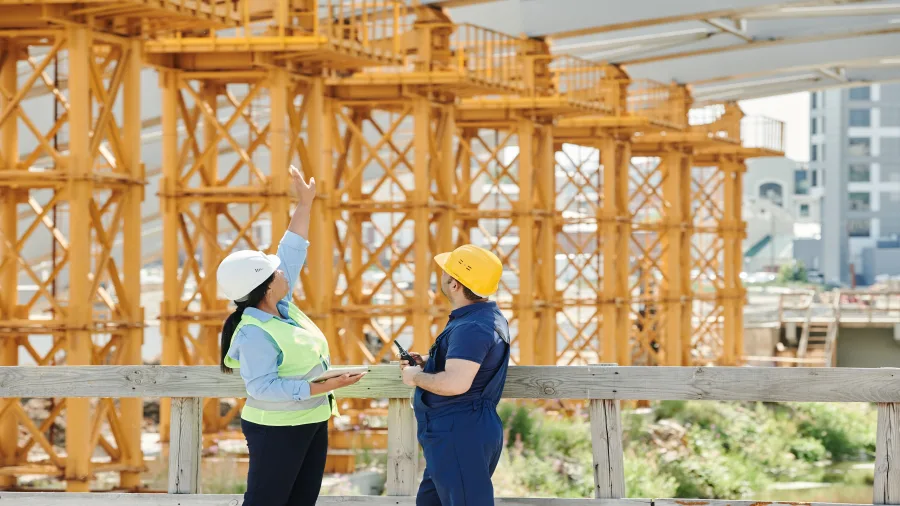
Every construction project, from a neighborhood retail center to a multi-story hospital, starts as an idea on paper and ends as a physical structure that must be delivered on time, within budget, and to the required quality standard. The discipline that makes that transformation possible is construction project management.
According to the Project Management Institute (PMI), organizations that invest in proven project management practices waste 28 times less money than those that do not. In construction, where material costs, labor productivity, and schedule delays directly affect profitability, that difference is the line between a successful project and a costly one.
This guide covers everything construction professionals need to know about construction project management, including the core phases of a project lifecycle, the key team members and their responsibilities, essential software tools, project delivery methods, and the most common challenges that cause projects to fall behind schedule and over budget.
Ready To Work With An Estimating Team You Can Actually Rely On?
What is Construction Project Management?
Construction project management (CPM) is the application of project management knowledge, skills, tools, and techniques to plan, coordinate, and control a construction project from initiation through closeout. It integrates every aspect of the build, such as architecture, engineering, procurement, construction, and commissioning, into a unified, managed workflow.
Effective construction project management controls four fundamental dimensions of every project:
|
Dimension |
What It Controls |
Key Tools |
|---|---|---|
|
Scope |
What work is included and excluded from the project |
Scope of work documents, RFI log, change order management |
|
Schedule |
When each activity starts and finishes |
Gantt charts, Critical Path Method (CPM scheduling), construction schedules |
|
Cost |
How much the project spends vs. the approved budget |
Cost estimates, earned value management (EVM), budget tracking |
|
Quality |
Whether completed work meets specified standards |
Quality control plans, inspection records, punch lists |
The Construction Project Management Team
Large commercial construction projects involve dozens of organizations and hundreds of individuals. Understanding who is responsible for what and how each role interacts with the others is fundamental to effective project management. Here are the key members of a construction project management team and their core responsibilities.
1. Project Owner
The project owner is the individual, company, or organization financing the project. The owner sets the project vision, establishes the budget, approves the design, selects the project delivery method, and makes the key decisions that shape project scope and direction. Owners may manage the project directly or engage an Owner's Representative or Construction Manager to act on their behalf.
-
Defines project goals, budget, and schedule requirements
-
Selects the architect, engineer, and contractor through a competitive bid or negotiated process
-
Approves design milestones, change orders, and pay applications
-
Accepts the completed project and takes ownership at closeout
2. Construction Project Manager
The construction project manager (CPM) is responsible for planning, coordinating, and supervising the day-to-day execution of the project. This person serves as the central communication hub between the owner, design team, general contractor, and subcontractors. Certified project managers often hold credentials from the Project Management Institute (PMP) or the Construction Management Association of America (CMAA).
-
Develops and maintains the project schedule using Gantt charts and Critical Path Method (CPM) scheduling
-
Manages the project budget and monitors costs using earned value management (EVM) techniques
-
Coordinates the work of all trade contractors and resolves scheduling conflicts
-
Manages the RFI (Request for Information) and submittal review process
-
Prepares and tracks change orders for any scope modifications
-
Conducts regular project status meetings and maintains accurate project documentation
-
Ensures compliance with OSHA safety regulations and project-specific safety plans
3. General Contractor (GC)
The general contractor holds the prime contract with the project owner and is responsible for all on-site construction activities. The GC manages the daily operations of the job site, coordinates all trade subcontractors, and is accountable for delivering the project on time, within budget, and to the required quality standards.
-
Manages subcontractor procurement, scheduling, and performance
-
Obtains all required building permits and licenses from the local authority having jurisdiction (AHJ)
-
Enforces the project safety plan and maintains OSHA compliance on the job site
-
Prepares and submits monthly pay applications and manages lien waivers
-
Maintains the project daily log, progress reports, and site documentation
-
Manages site logistics including material deliveries, waste removal, and temporary facilities
4. Construction Estimator
The construction estimator is responsible for calculating the complete cost of the project before construction begins. A thorough, accurate estimate is one of the most important documents in construction; it determines whether a contractor can bid competitively, win the contract, and execute the project profitably.
Professional construction estimators perform quantity takeoff (QTO) directly from architectural and structural drawings, price materials using current market rates and cost databases such as RSMeans by Gordian, calculate trade labor costs, and compile a complete Bill of Quantities (BOQ) organized by CSI MasterFormat division. Many contractors use purpose-built construction estimating software such as ProEst, PlanSwift, or Bluebeam Revu to ensure speed and accuracy.
5. Trade Subcontractors
Trade subcontractors are licensed specialty contractors hired by the general contractor to perform specific scopes of work that require specialized skills, equipment, or licensing. Common trade subcontractors on commercial projects include concrete, structural steel, mechanical (HVAC), electrical, plumbing, fire protection, drywall, flooring, and glazing contractors.
-
Perform their specific trade scope according to the construction documents and specifications
-
Submit material submittals and shop drawings for design team review and approval
-
Coordinate with other trades to avoid conflicts and maintain the project schedule
-
Self-perform quality control inspections before requesting owner or GC acceptance
-
Manage their own crew, equipment, and material procurement within the GC's schedule
6. Mechanical and Electrical Engineers (MEP Engineers)
MEP engineers, covering mechanical (HVAC), electrical, and plumbing systems, are essential members of the design team and play a critical role in construction project management. Their responsibilities span design through construction:
-
Design and specify all mechanical, electrical, and plumbing systems in the project
-
Review and approve trade subcontractor submittals and shop drawings for MEP systems
-
Perform site observations to verify that MEP installations comply with the design
-
Coordinate MEP system routing with structural and architectural elements using BIM (Building Information Modeling) coordination models
-
Provide cost input to the project estimator for mechanical, electrical, and plumbing scope
7. Architect of Record
The architect leads the design process, produces the construction documents, and serves as the owner's representative during construction. During the construction phase, the architect issues RFI responses, reviews contractor submittals, conducts site observation visits to verify design compliance, and issues certificates of substantial completion.
The 5 Phases of Construction Project Management
The construction project lifecycle follows five sequential phases, each building on the work of the previous one. Understanding these phases and the activities, decisions, and deliverables that belong in each is essential for any construction professional.
Phase 1: Project Initiation
Project initiation is the pre-design phase where the project concept is evaluated for viability before any significant investment is made. This phase answers the fundamental question: is this project worth pursuing?
-
Feasibility Study: The project team evaluates the construction cost, site suitability, regulatory environment, and financial return. A preliminary budget estimate is developed based on square foot cost models or conceptual design assumptions. AACE International classifies this as a Class 5 estimate with a typical accuracy range of +/- 30 to 50 percent.
-
Project Initiation Document (PID): The formal document that defines the project scope, objectives, stakeholders, constraints, and success criteria. The PID authorizes the project to proceed.
-
Stakeholder Identification: All parties with an interest in the project — owner, financiers, end users, neighbors, regulators — are identified, and their requirements are documented.
-
Project Delivery Method Selection: The owner selects the project delivery method (Design-Bid-Build, Design-Build, CM at Risk) that best fits the project's risk profile, budget, and schedule requirements.
Phase 2: Pre-Construction
Pre-construction is where the project transforms from an approved concept into a detailed, executable plan. This phase is critical, mistakes made in pre-construction are far more expensive to correct once construction begins.
-
Design Development: The architect and engineering team develop the design from schematic concepts through design development and construction documents. BIM (Building Information Modeling) is used on most commercial projects to coordinate structural, architectural, and MEP systems in a 3D model before construction begins.
-
Detailed Cost Estimating: A detailed construction estimate is produced from the completed construction documents. This estimate drives the contractor selection process and establishes the project control budget. Professional construction estimating services use digital quantity takeoff tools and RSMeans cost data to achieve estimate accuracy of +/- 5 to 10 percent.
-
Contractor Procurement: The GC and major trade subcontractors are selected through a competitive bid process or negotiated agreement. Subcontractor bids are leveled to ensure scope equivalency before award.
-
Risk Assessment: The project team identifies and quantifies key project risks, site conditions, design conflicts, long-lead materials, and regulatory approvals and develops mitigation strategies for each.
-
Permitting and Regulatory Approvals: Building permit applications are submitted to the authority having jurisdiction (AHJ). Any required environmental, zoning, or utility approvals are obtained before the construction start date.
-
Construction Schedule Development: The GC develops the master construction schedule using Critical Path Method (CPM) scheduling, identifying the critical path, the sequence of activities that determines the earliest possible project completion date.
Phase 3: Procurement
The procurement phase bridges pre-construction planning and physical construction. During procurement, all materials, equipment, and specialty services required for the project are identified, sourced, and contracted.
-
Long-lead items (structural steel, custom glazing, mechanical equipment, elevators) are identified early and purchase orders are issued to secure delivery dates that align with the construction schedule
-
Material submittals and shop drawings are prepared by suppliers and subcontractors, reviewed by the design team, and approved before fabrication or delivery
-
Subcontract agreements are finalized and executed with all trade contractors, establishing scope, schedule, cost, and insurance requirements
-
A procurement log is maintained to track the status of every material order and submittal approval throughout the project
Phase 4: Construction and Monitoring
The construction phase is where the project plan becomes a physical structure. The project manager's role shifts from planning to monitoring, controlling, and coordinating, ensuring that the work being performed matches the approved plans, budget, and schedule.
-
Schedule Management: The PM monitors actual construction progress against the CPM schedule every week. Any activities that fall behind schedule are analyzed for impact on the critical path, and recovery plans are developed and implemented.
-
Cost Control and Earned Value Management (EVM): Cost is tracked against the project control budget using earned value management (EVM) techniques, which compare the budgeted cost of work performed (BCWP) against the actual cost of work performed (ACWP) to identify cost and schedule variances in real time.
-
Quality Control: The GC's quality control program specifies inspection and testing requirements for every major scope of work. Failing inspections, non-conforming work, and specification deviations are documented and corrected before the work is accepted.
-
Safety Management: OSHA compliance is maintained through daily site safety inspections, toolbox talks, incident reporting, and enforcement of the project-specific safety plan. The GC is responsible for maintaining a safe work environment for all workers on the project.
-
RFI and Change Order Management: Design questions from subcontractors are submitted as Requests for Information (RFIs) and tracked through the design team's review and response process. Approved changes to scope, schedule, or cost are processed as formal change orders.
-
Documentation and Reporting: The project manager maintains daily logs, progress photos, meeting minutes, inspection records, and the submittal register, creating a complete, auditable record of project execution.
Phase 5: Project Closeout
Project closeout is the final phase in which the completed construction is inspected, tested, documented, and formally transferred to the project owner. A well-managed closeout protects both the contractor and the owner and ensures that all contractual obligations are fulfilled.
-
Construction punch list: The PM and owner walk the completed project together and document all outstanding items, incomplete work, deficiencies, or items not meeting specifications on a formal punch list. All punch list items must be resolved before final payment is released.
-
Final inspections and certificates of occupancy are obtained from the authority having jurisdiction (AHJ) to confirm the building meets all code requirements.
-
As-built drawings (record drawings) are compiled by the GC and submitted to the owner, documenting any field changes made during construction.
-
Operations and maintenance (O&M) manuals and equipment warranties are compiled and delivered to the owner.
-
Final pay application, retention release, and all subcontractor lien waivers are processed to close out project financials.
-
A post-project lessons-learned review is conducted to document what went well, what caused problems, and what the team would do differently, feeding this knowledge back into future project estimates and planning.
Construction Project Delivery Methods
The project delivery method defines how the owner, designer, and contractor relate to each other contractually and organizationally. Selecting the right delivery method for a specific project has a significant impact on risk allocation, cost, schedule, and project outcomes.
|
Delivery Method |
How It Works |
Best For |
Key Advantage |
Key Risk |
|---|---|---|---|---|
|
Design-Bid-Build (DBB) |
Owner hires an architect first, then competitively bids the completed design to general contractors |
Public projects, well-defined scope |
Maximum price competition, clear accountability |
Longest schedule; design errors discovered late |
|
Design-Build (DB) |
A single entity (design-builder) is responsible for both design and construction |
Fast-track projects, experienced owners |
Fastest delivery, single point of responsibility |
Less owner control over design details |
|
CM at Risk (CMAR) |
Construction manager is hired early during design to provide cost input, then delivers the project at a Guaranteed Maximum Price (GMP) |
Complex projects, budget-sensitive owners |
Early contractor input, cost certainty at GMP |
GMP scope definition requires careful attention |
|
Integrated Project Delivery (IPD) |
Owner, architect, and contractor share risk and reward under a single multi-party agreement |
Complex, technically demanding projects |
Highest collaboration, best BIM integration |
Complex contract structure, limited track record |
Types of Construction Projects
Construction project management principles apply across a wide range of project types, each with its own unique characteristics, regulatory requirements, and management challenges. The construction industry is generally divided into the following major project categories:
|
Project Type |
Examples |
Key Management Challenges |
|---|---|---|
|
Commercial Building |
Office buildings, retail centers, hotels, restaurants |
Tenant coordination, finish quality, fast-track scheduling |
|
Institutional |
Hospitals, schools, government buildings, universities |
Infection control, occupied facility construction, funding compliance |
|
Industrial |
Manufacturing plants, warehouses, distribution centers |
Process equipment coordination, heavy structural loads, utility infrastructure |
|
Residential |
Single-family homes, apartment complexes, condominiums |
Multiple unit repetition, buyer customization, HOA coordination |
|
Heavy Civil / Infrastructure |
Highways, bridges, tunnels, airports, rail |
Environmental permitting, public safety, utility relocation |
|
Petroleum and Energy |
Refineries, pipelines, power plants, solar and wind farms |
Hazardous materials, complex MEP systems, remote site logistics |
|
Water and Environmental |
Water treatment plants, wastewater systems, environmental remediation |
Regulatory compliance, community impact, long permitting timelines |
Construction Project Management Software
Modern construction project management relies on purpose-built software platforms to manage scheduling, documentation, cost control, and team communication. The right tools reduce administrative burden, improve data accuracy, and keep distributed project teams aligned. Here are the leading platforms used by construction project management professionals:
|
Software |
Best For |
Key Features |
|---|---|---|
|
Procore |
General contractors and owners on commercial projects |
Project management, document control, financial management, quality and safety, real-time dashboards |
|
Buildertrend |
Residential builders, remodelers, and specialty contractors |
Scheduling, client communication portal, budget tracking, daily logs, change order management |
|
PlanGrid (Autodesk Build) |
Field teams needing real-time drawing access |
Blueprint management, punch lists, RFI tracking, offline access, real-time plan updates |
|
CoConstruct |
Custom home builders and high-end remodelers |
Client selections portal, budget management, job costing, subcontractor communication |
|
Fieldwire |
Field supervisors and job site crews |
Task management, blueprint viewing, punch lists, real-time office-to-field communication |
|
Smartsheet |
Project managers needing flexible tracking tools |
Gantt chart scheduling, resource management, automated workflows, team collaboration |
|
RedTeam |
Commercial general contractors |
Project financials, document management, subcontract management, compliance tracking |
|
Oracle Primavera P6 |
Large infrastructure and industrial projects |
Advanced CPM scheduling, resource leveling, multi-project portfolio management |
|
Microsoft Project |
Small to mid-size projects with existing Microsoft ecosystems |
Gantt scheduling, resource allocation, budget tracking, Office 365 integration |
Common Challenges in Construction Project Management
1. Stakeholder Coordination and Communication
A single commercial construction project may involve the owner, architect, structural and MEP engineers, a general contractor, 15 to 30 trade subcontractors, material suppliers, the local authority having jurisdiction, and multiple inspectors, all with different priorities, schedules, and communication styles. Keeping all of these parties aligned requires disciplined communication protocols, a clear decision-making hierarchy, and consistent documentation of all project communications.
2. Scope Creep and Change Order Management
Scope creep, the accumulation of small, unauthorized additions to the project scope is one of the most common causes of budget overruns on construction projects. Professional project managers prevent scope creep by maintaining a rigorous change order process: every requested change to the scope, schedule, or cost must be formally documented, priced, and approved in writing before the work proceeds.
3. Schedule Delays and Critical Path Management
Construction schedules are complex, interdependent networks of activities. A delay in one critical path activity, a long-lead structural steel delivery, a permit approval, a concrete pour that must cure before the next trade can start can cascade through the schedule and push back the project completion date. Effective schedule management requires weekly CPM schedule updates, early identification of activities at risk, and proactive recovery planning.
4. Site Conditions and Unforeseen Conditions
Even with thorough geotechnical investigations and site surveys, construction projects frequently encounter unforeseen conditions, contaminated soil, unmarked underground utilities, deteriorated existing structures, or subsurface rock. These conditions require immediate assessment, design response, and often a change order to address. Projects that include appropriate contingency allowances and have established change order procedures handle unforeseen conditions with far less disruption.
5. Safety Management and OSHA Compliance
The construction industry consistently has one of the highest workplace fatality and injury rates of any sector in the United States. OSHA regulations establish minimum safety standards for construction sites, but leading construction companies go far beyond minimum compliance, implementing comprehensive safety programs, conducting regular safety training, performing daily site inspections, and holding everyone on the project accountable for maintaining a safe work environment.
6. Weather and Force Majeure Events
Weather is an unavoidable factor on every outdoor construction project. Rain, extreme heat or cold, high winds, and severe storms can halt construction activities, damage completed work, and compromise the safety of on-site workers. Professional project managers monitor weather forecasts, plan critical outdoor activities around weather windows, build appropriate floats into the schedule for weather days, and document weather-related delays for potential schedule extension claims.
7. Labor Availability and Productivity
The US construction industry faces a well-documented skilled labor shortage. The Associated General Contractors of America (AGC) reports that the majority of construction firms struggle to find qualified craft workers, particularly in specialty trades such as electrical, plumbing, and concrete. Labor shortages affect productivity rates, increase labor costs, and can directly threaten project schedules. Effective project managers build labor availability risks into their schedules and cost estimates and maintain strong relationships with reliable subcontractors and staffing sources.
Conclusion
Construction project management is not a single skill; it is a discipline that integrates cost control, schedule management, team coordination, risk management, quality assurance, safety compliance, and client communication into a unified, structured approach to project delivery.
The projects that finish on time, within budget, and to the required quality standard are not the ones that got lucky. They are the ones managed by professionals who understood the critical path, controlled scope rigorously, built accurate estimates, coordinated their trade partners effectively, and maintained clear communication with every stakeholder from initiation through closeout.
At Federal Estimating, we support construction project teams at every phase of the project lifecycle. From pre-construction quantity takeoffs and detailed cost estimates to subcontractor bid packages and value engineering analysis, our certified estimating professionals deliver the accurate, fast, and reliable cost data that project managers and owners need to make confident decisions and deliver profitable projects.
Ready to strengthen your pre-construction process? Contact Federal Estimating today for a free consultation. Our team of certified professional estimators is ready to support your next commercial or residential project, from conceptual budget through bid-ready estimate. Visit federalestimating.com to get started.
The Critical Path Method (CPM) is a scheduling technique that identifies the longest sequence of dependent activities in a project, the critical path which determines the earliest possible project completion date. Any delay to a critical path activity directly delays project completion. CPM scheduling is the industry standard for managing complex construction projects and is required by most government contracts and large commercial owners. Software platforms such as Oracle Primavera P6 and Microsoft Project are used to develop and maintain CPM schedules.
Earned value management (EVM) is a project performance measurement technique that integrates scope, schedule, and cost into a single performance framework. In construction, EVM compares the budgeted cost of work planned (BCWP) against the actual cost of work performed (ACWP) to generate cost performance index (CPI) and schedule performance index (SPI) metrics. These metrics provide project managers with an early warning system for cost overruns and schedule delays, enabling corrective action before problems become unmanageable.
A general contractor (GC) holds the prime contract for construction, assumes financial risk for delivering the project at the contract price, and directly manages trade subcontractors. A construction manager (CM) typically acts as the owner's agent or advisor, providing management services for a fee rather than assuming financial risk for construction costs. In a CM at Risk arrangement, the CM assumes the contractor role and delivers the project at a Guaranteed Maximum Price (GMP), combining elements of both models.
Building Information Modeling (BIM) is a digital design and coordination technology that creates an intelligent 3D model of a building that contains not just geometry but also information about every building component — materials, specifications, costs, and installation sequences. In construction project management, BIM is used for clash detection (identifying conflicts between structural, architectural, and MEP systems before construction begins), quantity takeoff, construction sequencing (4D BIM), cost management (5D BIM), and facilities management handover to the building owner.
Studies consistently show that the majority of large construction projects experience cost or schedule overruns. McKinsey Global Institute research found that large construction projects average 80 percent over budget and take 20 percent longer than originally planned. The most common causes are poor pre-construction planning, inaccurate cost estimates, inadequate schedule management, and ineffective change order control — all of which are directly addressed by professional construction project management practices.
What Our Clients Say
Olivia

Federal Estimating saved us on a tight commercial bid. The numbers were accurate, the turnaround was fast, and the format was ready to submit. We won the job.

Marcus
We've used a lot of estimating services over the years. Federal Estimating is the only one that consistently delivers on time without sacrificing accuracy. Highly recommended.
Sarah
Daniel and the team understood exactly what we needed. The estimate was detailed, clean, and our client was impressed. We'll be coming back for every project.