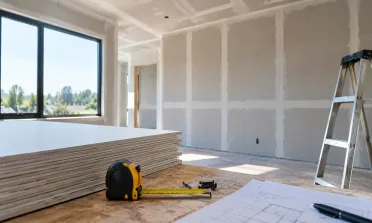

An undercounted material quantity doesn't announce itself at bid time; it shows up six weeks in when your crew runs short, and your supplier charges rush pricing. By that point, the cost impact is triple what a thorough takeoff would have caught. Our specialists measure every scope item methodically, leaving nothing between trades or drawing sheets.
Quantity Takeoff Services Built for Bid-Ready Accuracy
Every bid, budget, and procurement decision your team makes starts with one question: how much does this project actually require? When takeoffs are rushed or built on assumptions, every number downstream inherits that error.
Our quantity takeoff services provide precise, trade-ready measurements before pricing begins.
Why Inaccurate Quantity Takeoffs Are Quietly Undermining Your Bids
What's Included in Our Quantity Takeoff Services
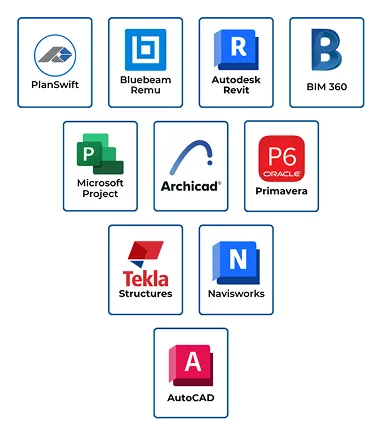
Tools We Use for Quantity Takeoffs
- PlanSwift
- Bluebeam Revu
- On-Screen Takeoff (OST)
- AutoCAD
- STACK Takeoff
- RSMeans Data Online
- Autodesk BIM 360
- Microsoft Excel
- Trimble Business Center
Who We Provide Takeoffs For
Our takeoff services support every professional who needs accurate material counts and scope measurements to price work confidently.
Get Your Estimates NowHow Our Process Works
A methodical, trade-by-trade workflow built to deliver complete, verified quantity data on your construction project, helping you improve cost accuracy, reduce estimating errors, and make informed bidding decisions.
-
01
Submit Plans
Upload your drawings and project documents.
-
02
Review Scope
We analyze every detail of your project scope using industry-standard tools, ensuring nothing is missed
-
03
Cost Estimate
We build a precise, itemized estimate covering all materials, labor, and trade-specific costs.
-
04
Bid-Ready Delivery
Your completed estimate lands in your inbox.
What Our Customers Say
Frequently Asked Questions
Pricing is based on project size, number of trades, drawing complexity, and required turnaround. Single-trade takeoffs for residential or small commercial projects start at $150 to $300. Full multi-trade packages for mid-sized commercial projects typically range from $500 to $1,500. Large civil, subdivision, or complex commercial projects are quoted individually after reviewing your drawing set. We provide a firm, fixed price before work begins, with no open-ended billing.
Turnaround depends on project scope and the number of trades being measured. Single-trade takeoffs for straightforward projects are typically completed within one to two business days. Mid-sized multi-trade commercial takeoffs are delivered within three to five business days. Large civil, subdivision, or complex multi-story projects are scoped individually with delivery timelines confirmed upfront. Rush turnaround is available; provide your bid date when submitting, and we'll confirm feasibility immediately.
We cover the full range of construction disciplines, including earthwork, civil grading, concrete, formwork, structural steel, wood framing, masonry, roofing, waterproofing, exterior cladding, mechanical HVAC, plumbing, electrical, fire protection, interior finishes, doors, hardware, glazing, and specialties. Whether you need a single-trade takeoff or a complete multi-trade package across the full project, we have discipline specialists in-house for every scope.
We work from PDF plan sets, CAD files in DWG or DXF format, Revit models, and high-resolution scanned drawings. For BIM quantity extraction, we work directly in Revit or from exported IFC files. The more complete and legible your documents, the faster and more precise your takeoff, but we're experienced working with documents at every stage of design completeness, including early schematic drawings.
Our takeoffs are performed by trade specialists measuring directly from construction drawings using calibrated digital tools, not rules of thumb or square-footage approximations. Every measurement references a specific drawing location, and every takeoff undergoes an internal quality review before delivery. For projects with complete drawing sets, our quantities consistently align within industry-standard accuracy tolerances. Where drawings have gaps, we document assumptions transparently so you know exactly where variability exists.
Yes, and for projects with a sufficiently detailed, accurate BIM model, we prefer it. Model-based extraction is faster and geometrically more precise than manual 2D measurement, particularly for complex structural elements, curved geometry, and multi-system MEP scopes. We verify model completeness and LOD before extraction, cross-reference quantities against the drawing intent, and flag any elements that are insufficiently detailed for reliable quantity extraction before finalizing the report.
Yes. Civil and earthwork takeoffs are a core specialty for our team. We calculate cut-and-fill volumes from grading plans, measure paving areas and thicknesses, count drainage structures, measure pipe quantities by diameter and material, and produce utility quantity lists for water, sewer, and storm systems. For subdivision and roadwork projects, we organize civil quantities by phase and area to support phased scheduling and procurement planning.
Absolutely. Many clients, such as estimating firms, GCs with high bid volume, and specialty contractors bidding multiple projects simultaneously, use us as a dedicated outsourced takeoff resource continuously. Over time, we develop familiarity with your preferred output format, organizational standards, and trade priorities, which means each successive takeoff requires less setup and delivers faster, more consistent results for your estimating team.
Our takeoff service focuses exclusively on quantity measurement, like counting and measuring every material and unit of work with precision. Pricing involves local labor rates, current material costs, supplier relationships, and markup decisions that your estimating team is best positioned to apply. If you need both in one deliverable, our cost estimating service can be combined with the takeoff to produce a fully priced estimate. Just specify that requirement when you submit.
Yes. Subdivision and roadwork projects involve extensive civil quantities, such as paving tonnage, curb and gutter linear footage, storm drain pipe and structure counts, earthwork volumes, and utility quantities across large site areas where errors have an outsized cost impact. We organize all civil quantities by phase and site area so land developers, civil engineers, and public works contractors can price infrastructure scopes accurately and manage procurement across multi-phase programs.