
There is no single right number, which is the whole point. On a simple roof, I typically carry about 5 to 8 percent for TPO, 3 to 5 percent for EPDM because of its large sheet format, and 5 to 10 percent for metal panels. On complex roofs with heavy penetrations or cut-up hip and valley geometry, all three climb, with TPO reaching 10 to 15 percent, EPDM 8 to 12 percent, and metal often 12 percent or more. Applying a flat rate across every system is one of the fastest ways to misprice a roofing bid.
TPO vs. EPDM vs. Metal Roofing: Estimating Differences You Must Know
Why do two roofing contractors bidding on the same building come back with numbers that are thousands of dollars apart, even when both are quoting quality work? After years of building roofing estimates for contractors and subs across the country, I can tell you the answer is rarely dishonesty and rarely a wild guess on price. The gap usually comes down to how each estimator handled the system itself. A TPO membrane, an EPDM rubber roof, and a standing seam metal system are not three versions of the same estimate with a different unit cost dropped in. They are three separate takeoffs, three different labor models, and three distinct sets of line items. Treat them the same way and you will either lose the bid or win it and quietly lose money on the job.
In this guide, I walk through exactly where these three systems diverge on the estimating table, from how I measure and apply waste, to how the line items change, to the labor productivity numbers that decide whether your margin holds. If your roofing bids feel inconsistent from one system to the next, this is usually where the problem lives.
Ready To Work With An Estimating Team You Can Actually Rely On?
Why the Same Building Does Not Mean the Same Estimate
The first mistake I see contractors make is assuming a roof is a roof. On paper, the three systems share a starting point: you measure the roof area, and you price what goes on it. In practice, the moment you move past raw square footage, they behave nothing alike.
TPO and EPDM are both single-ply membranes measured in square feet, and to an outsider they look interchangeable. But EPDM ships in far larger sheets, which changes your seam count, your waste, and your labor approach. Metal is a different animal entirely. You are no longer estimating a membrane rolled across a field. You are estimating panels with a fixed coverage width, clips or fasteners at a defined spacing, and a long list of trim and flashing measured in linear feet. The measurement unit, the waste logic, and the risk all shift.
According to the National Roofing Contractors Association's market data, single-ply systems such as TPO and EPDM dominate the low-slope commercial market, while metal holds a strong position in sloped and architectural work. That split matters because it tells you the wrong system in the wrong estimate template is a common and expensive error. You can read the industry breakdown through the NRCA if you want the underlying survey figures.
How I Take Off Each System (and Why the Waste Factor Changes)
Waste factor is where a lot of roofing bids silently go wrong. Applying a flat 10% to every system, regardless of type or complexity, will overprice a simple flat roof and underprice a complex cut-up metal roof. Here is how I actually approach each one.
1. TPO Takeoff
I measure the roof area in square feet, then order membrane by dividing that area by the roll coverage and adding for seam overlap and field cuts. TPO rolls are commonly ten feet wide, so seams add up quickly on a large field. On a clean rectangular commercial roof, I typically carry a 5 to 8 percent waste factor.
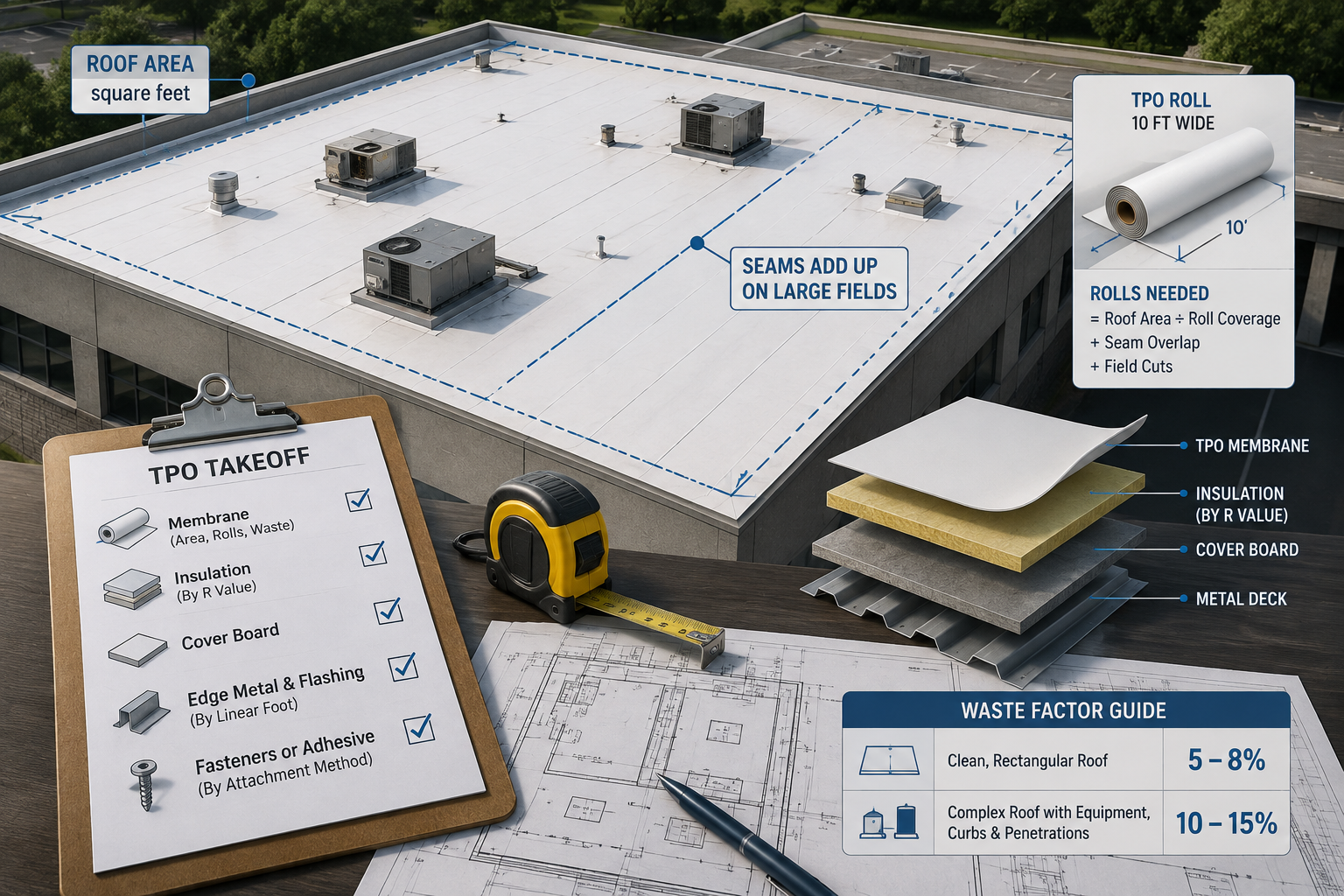
Once you introduce heavy rooftop equipment, curbs, and penetrations, that climbs to roughly 10 to 15 percent because the membrane cannot run in clean sheets around every obstacle. Beyond the membrane, I break out insulation by R value, cover board, edge metal and flashing by linear foot, and fasteners or adhesive by the attachment method.
2. EPDM Takeoff
EPDM is measured the same way on the surface, area plus waste, but the large sheet format changes the math. Because EPDM comes in sheets up to fifty feet wide, a simple warehouse roof can produce very little cutting waste, so I often carry as low as 3 to 5 percent on straightforward jobs.
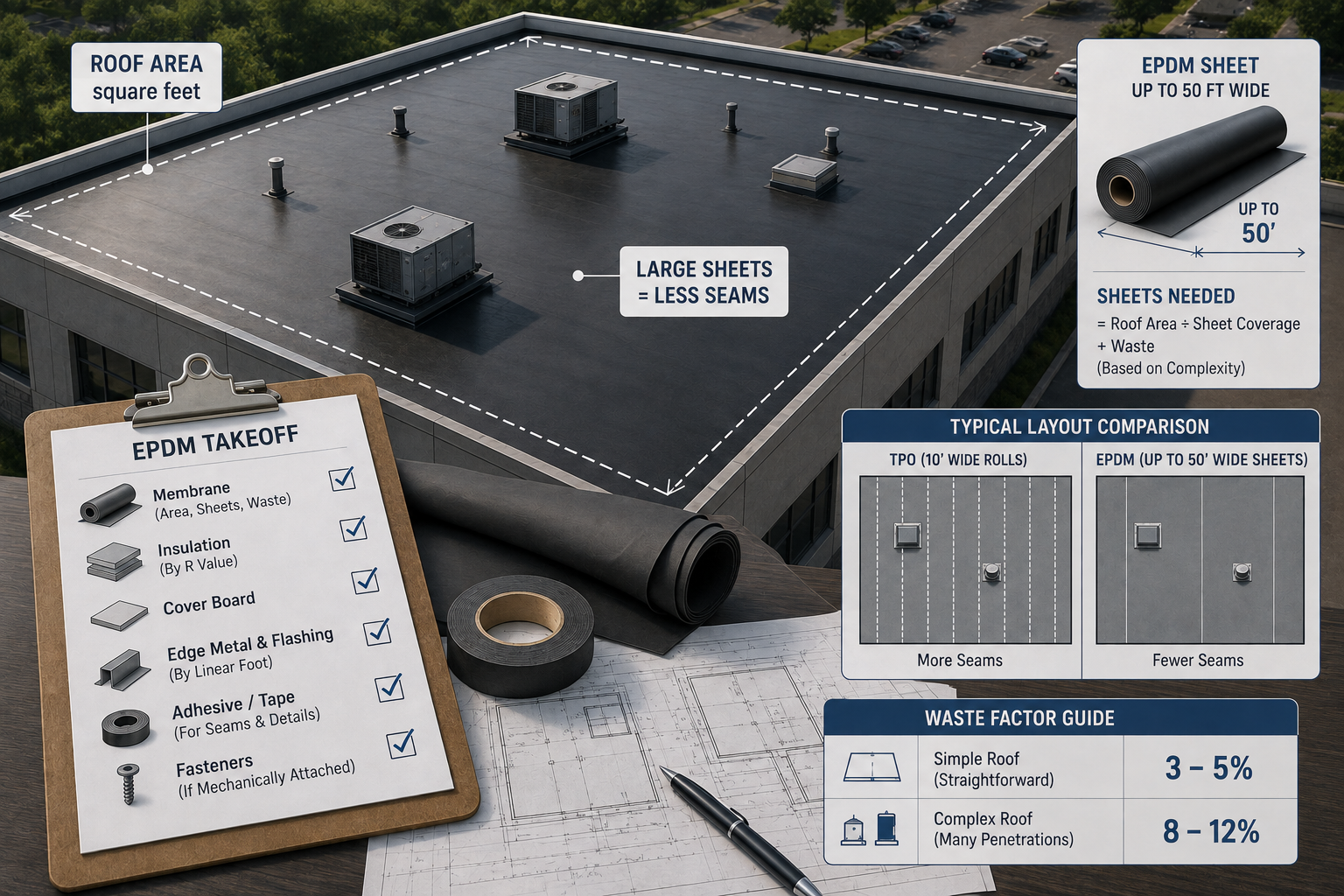
Complex EPDM roofs with many penetrations move up to 8 to 12 percent, since those oversized sheets stop being an advantage once you are cutting around obstacles. The seam and adhesive line items also differ from TPO, which uses heat-welded seams instead of tape or adhesive.
3. Metal Roofing Takeoff
Metal is where most generic estimates fall apart, and it is exactly where competitors tend to go quiet. I do not order metal by the square foot the way I do a membrane. I calculate the number of panels based on the panel coverage width and the roof run, then add for rake and hip cuts.
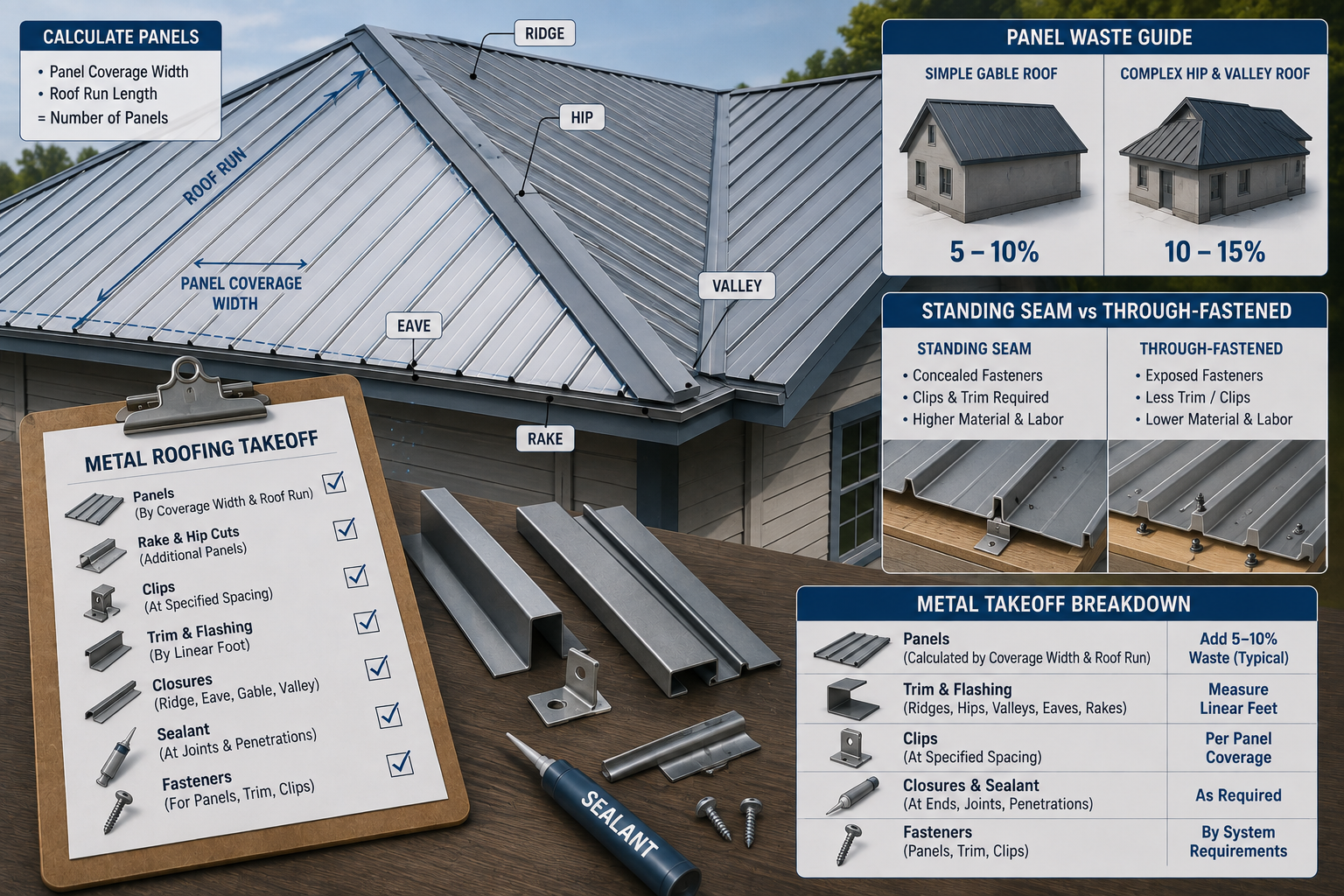
On a standing seam system, I also estimate clips at their specified spacing, trim and flashing by linear foot at ridges, hips, valleys, eaves, and rakes, plus closures, sealant, and fasteners. Panel waste usually runs 5 to 10 percent on a simple gable and climbs on cut-up hip and valley roofs where every panel gets trimmed. The distinction between a standing seam and a through-fastened panel also changes both material and labor, so I never lump them together.
Estimating Differences at a Glance
The table below summarizes how the three systems diverge across the numbers that actually move a bid. Installed cost ranges are 2026 general market figures and vary widely by building size, attachment method, insulation, region, and complexity.
|
Factor |
TPO |
EPDM |
Metal (Standing Seam) |
|---|---|---|---|
|
Measured in |
Square feet (membrane) |
Square feet (membrane) |
Panels + linear feet of trim |
|
Typical waste (simple) |
5 to 8% |
3 to 5% |
5 to 10% |
|
Typical waste (complex) |
10 to 15% |
8 to 12% |
12%+ on cut-up roofs |
|
Key extra line items |
Heat welded seams, insulation, cover board, edge metal |
Adhesive/tape seams, large sheets, insulation, flashing |
Clips, closures, ridge/hip/valley trim, fasteners |
|
Installed cost range |
~$6 to $12 / sq ft |
~$4 to $8 / sq ft |
~$10 to $18+ / sq ft |
|
Biggest estimating risk |
Seam labor + penetration waste |
Underpricing complex penetration work |
Panel count + trim LF miscount |
Note: Figures are general 2026 market ranges for context, not a quote. Regional labor and material rates typically dominate the final number.
Labor Productivity: The Number That Quietly Breaks Bids
Material is the easy part. Labor is where estimates for these three systems separate the most, and it is the line most likely to sink a bid. Single-ply membranes install fast, which is a large part of why they dominate low-slope commercial work. Metal, by contrast, is slower and far more detail-heavy, because every panel has to be set, seamed or fastened, and finished with trim.
Within the membranes, TPO and EPDM are not identical on labor either. TPO seams are heat welded, which requires specialized equipment and a skilled operator, so I carry more seam labor per linear foot than I would on a taped or adhered EPDM seam. EPDM ships in bigger sheets, so on a simple roof the field goes down quickly, but complex penetration work erases that advantage fast. Metal roofing labor is driven by panel handling, clip installation, and the sheer volume of trim, so I estimate it in a completely different productivity band. If you copy a membrane labor rate onto a metal job, you will underbid it badly.
Attachment Method Moves the Estimate More Than the Brand
One thing homeowner-focused articles rarely mention is that how the roof is attached often changes your estimate more than which membrane you choose. A single-ply roof can be mechanically fastened, fully adhered, or ballasted, and each path carries a different labor rate, a different fastener or adhesive line item, and a different wind uplift consideration.
A fully adhered system uses more adhesive and more careful labor. A mechanically fastened system needs a fastener and plate count tied to the wind zone and the field, perimeter, and corner spacing. A ballasted system adds the weight of stone and its own uplift math. I always confirm the attachment method before I finalize a single-ply estimate, because two bids on the same TPO roof can differ significantly based solely on this choice. Missing it is one of the most common reasons a bid comes in low and the job comes in over budget.
The Estimating Mistakes I See Most on Each System
-
Flat waste factor across the board. Applying one waste percentage to TPO, EPDM, and metal ignores how differently each behaves around penetrations and cuts.
-
Forgetting metal trim. On metal, the ridge, hip, valley, eave, and rake trim in linear feet can rival the panel cost, yet it is the first thing an inexperienced estimator underestimates.
-
Ignoring attachment method. Pricing a membrane roof without confirming adhered, fastened, or ballasted leaves a real gap in both material and labor.
-
Copying membrane labor onto metal. Metal installs slower and needs more detail work, so a membrane productivity rate will underprice it every time.
-
Skipping the cover board and insulation split. On low slope work, these are separate line items with their own quantities, not a rounding allowance.
What This Means for Your Bid Margin
The reason these differences matter is simple: your margin lives inside them. A precise, system-specific waste factor and an accurate labor band are the difference between a bid that wins profitably and one that either loses to a sharper competitor or wins and erodes your profit. On low-margin roofing work, where realized margins are often in the low double digits, a single misapplied waste factor or a forgotten trim run can swing a job from profitable to painful.
This is exactly the work my team does every day. When you outsource your roofing takeoffs and estimates to Federal Estimating, you get system-specific quantities, correct waste factors, and a clean line item structure that reflects how TPO, EPDM, and metal each actually get built and priced. If you want an estimate you can bid with confidence on any of these three systems, our reliable roofing estimating services give you senior-level takeoffs and estimates without adding headcount, so you can bid more jobs and protect the margin on every one.
If you are still deciding between doing it in-house or handing it off, it helps to compare the true cost of an in-house estimating desk against an outsourced partner before your next busy bidding season. Either way, the goal is the same: a number you can stand behind on bid day.
Bidding a TPO, EPDM, or metal roof this week? Send us the plans and get a system-specific takeoff and estimate back with correct waste factors, trim in linear feet, and a bid-ready line item breakdown. Request your roofing estimate.
Metal is not measured or priced like a membrane. Instead of ordering material by the square foot, you calculate panel counts based on coverage width and roof run, then add clips at a set spacing and a substantial amount of trim and flashing in linear feet at every ridge, hip, valley, eave, and rake. The trim alone can rival the panel cost. Standing seam and through-fastened panels also differ in both material and labor, so metal needs its own estimating approach rather than a membrane template with a new unit cost.
Yes, and often more than the choice of membrane. A fully adhered system uses more adhesive and careful labor, a mechanically fastened system requires a fastener and plate count tied to wind zone spacing, and a ballasted system adds stone weight and its own uplift math. Two bids on the same TPO roof can differ significantly based only on the attachment method, so I always confirm it before finalizing a single-ply estimate.
As a general 2026 range, EPDM tends to be the most budget-friendly at roughly 4 to 8 dollars per square foot installed, TPO sits a little higher around 6 to 12 dollars, and standing seam metal is the most expensive upfront at roughly 10 to 18 dollars or more. Those numbers move heavily with building size, attachment method, insulation, region, and complexity, so treat them as context rather than a quote. Metal also delivers the longest service life, so the lowest install price is not always the lowest lifetime cost.
It depends on your bid volume and how consistent your current numbers are across systems. If your team is confident, well staffed, and rarely bidding metal alongside membranes, in-house can work well. If you are missing bids because you cannot turn estimates around fast enough, or your margins swing depending on who prepared the takeoff, outsourcing to senior estimators gives you system-specific accuracy without adding headcount. Many contractors use an outside partner during peak bidding season and keep simple jobs in-house.

What Our Clients Say
Olivia

Federal Estimating saved us on a tight commercial bid. The numbers were accurate, the turnaround was fast, and the format was ready to submit. We won the job.

Marcus
We've used a lot of estimating services over the years. Federal Estimating is the only one that consistently delivers on time without sacrificing accuracy. Highly recommended.
Sarah
The Federal Estimating's team understood exactly what we needed. The estimate was detailed and clean, and our client was impressed. We'll be coming back for every project.