





Multiply length by width by thickness, with all three in feet, then divide by 27 to convert cubic feet to cubic yards. For example, a 20 ft by 20 ft slab at 4 inches (0.333 ft) thick is about 133 cubic feet, or 4.93 cubic yards. The calculator does this for you and adds your chosen waste allowance.
Our concrete calculator turns four simple measurements into the numbers you actually need to place an order: cubic yards, cubic feet, cubic meters, total weight, and how many pre-mixed bags the job will take. Whether you are pouring a backyard patio slab, setting foundation footings, forming a round column, or building a short run of stairs, the tool does the geometry and the unit conversion so you are not doing long math on the back of a form board.
It works for the five shapes contractors run into most often: slabs, footings and walls, round columns, circular tubes, curbs and gutters, and stairs. You can enter feet, inches, yards, meters, or millimeters, and the calculator handles the conversion behind the scenes. That flexibility matters on real job sites, where a slab might be measured in feet but the depth is called out in inches.
How to Use This Concrete Calculator
Getting a usable number takes about thirty seconds. Here is the workflow:
-
Pick your shape
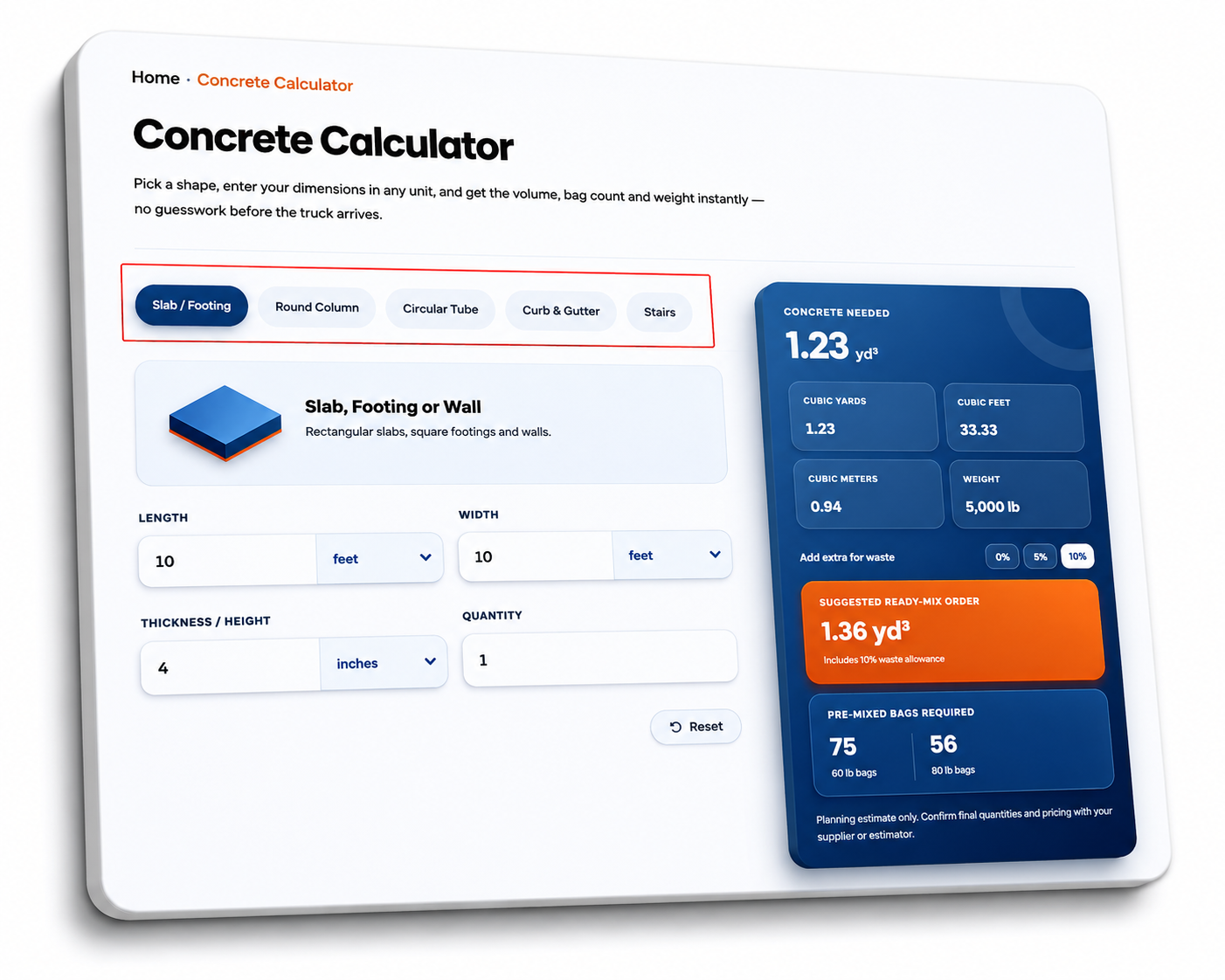
Start by selecting the shape that matches your pour: Slab, Footing or Wall, Round Column, Circular Tube, Curb and Gutter, or Stairs. Each one uses different geometry, so choosing the right shape is the first thing that keeps your estimate honest.
-
Enter your dimensions
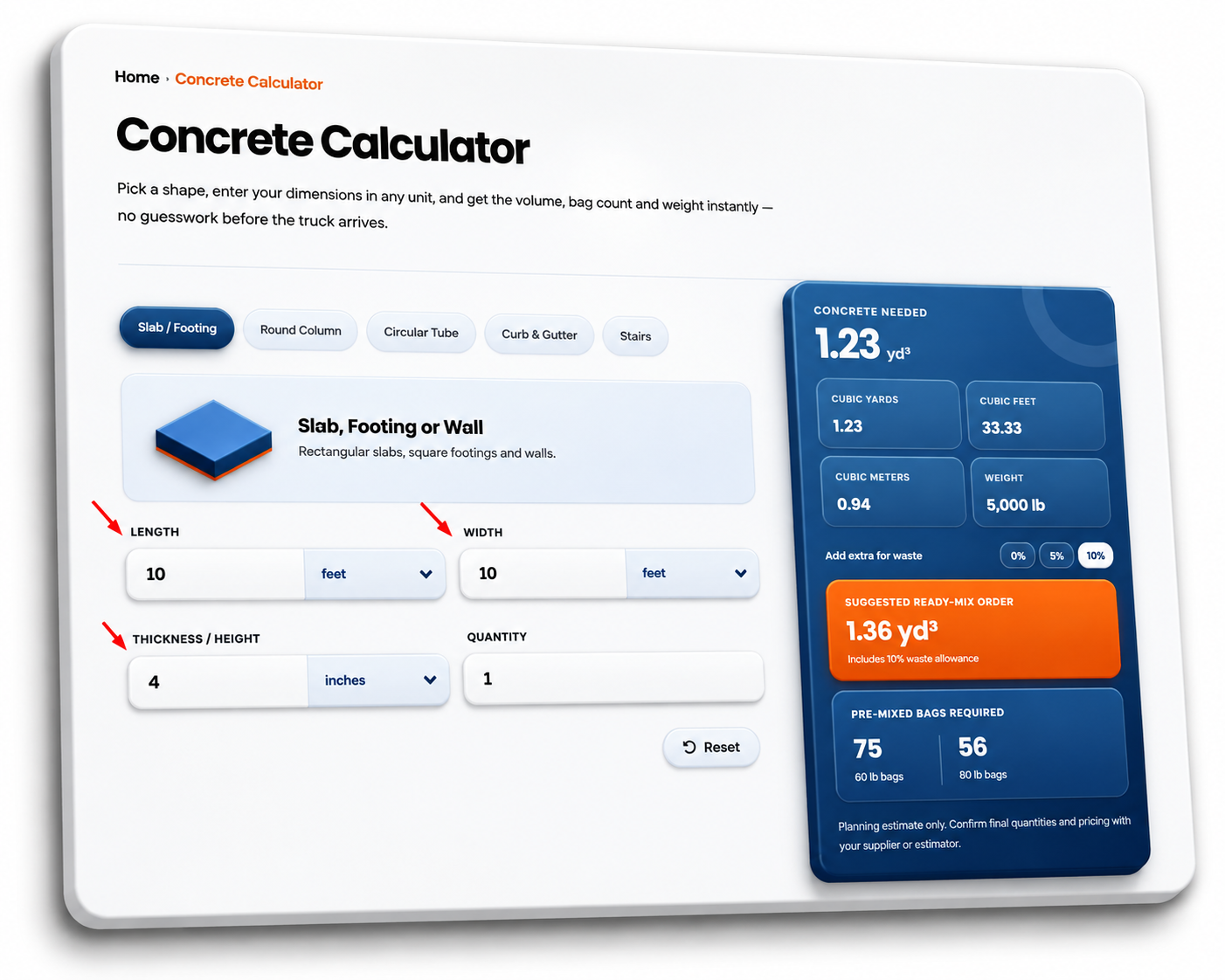
Type in your length, width, and thickness or height. You can use whatever unit you measured in, feet, inches, yards, meters, or millimeters, and mix them freely. For a standard slab, length and width set the footprint, and thickness sets the depth of the pour.
-
Set the quantity
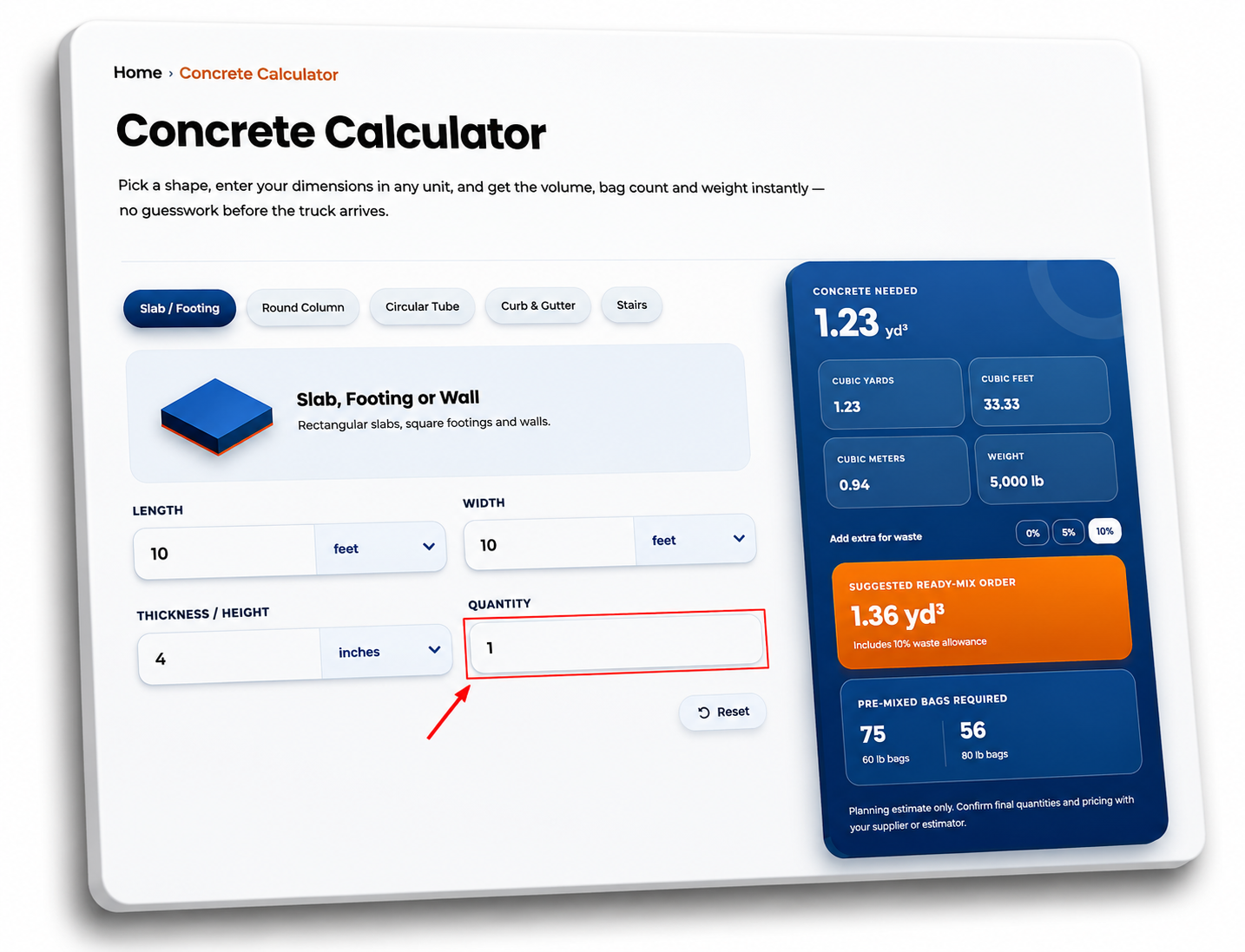
If you are pouring more than one identical footing, column, or step, enter the count. The calculator multiplies the volume so you do not have to run the same shape five times.
-
Add a waste allowance
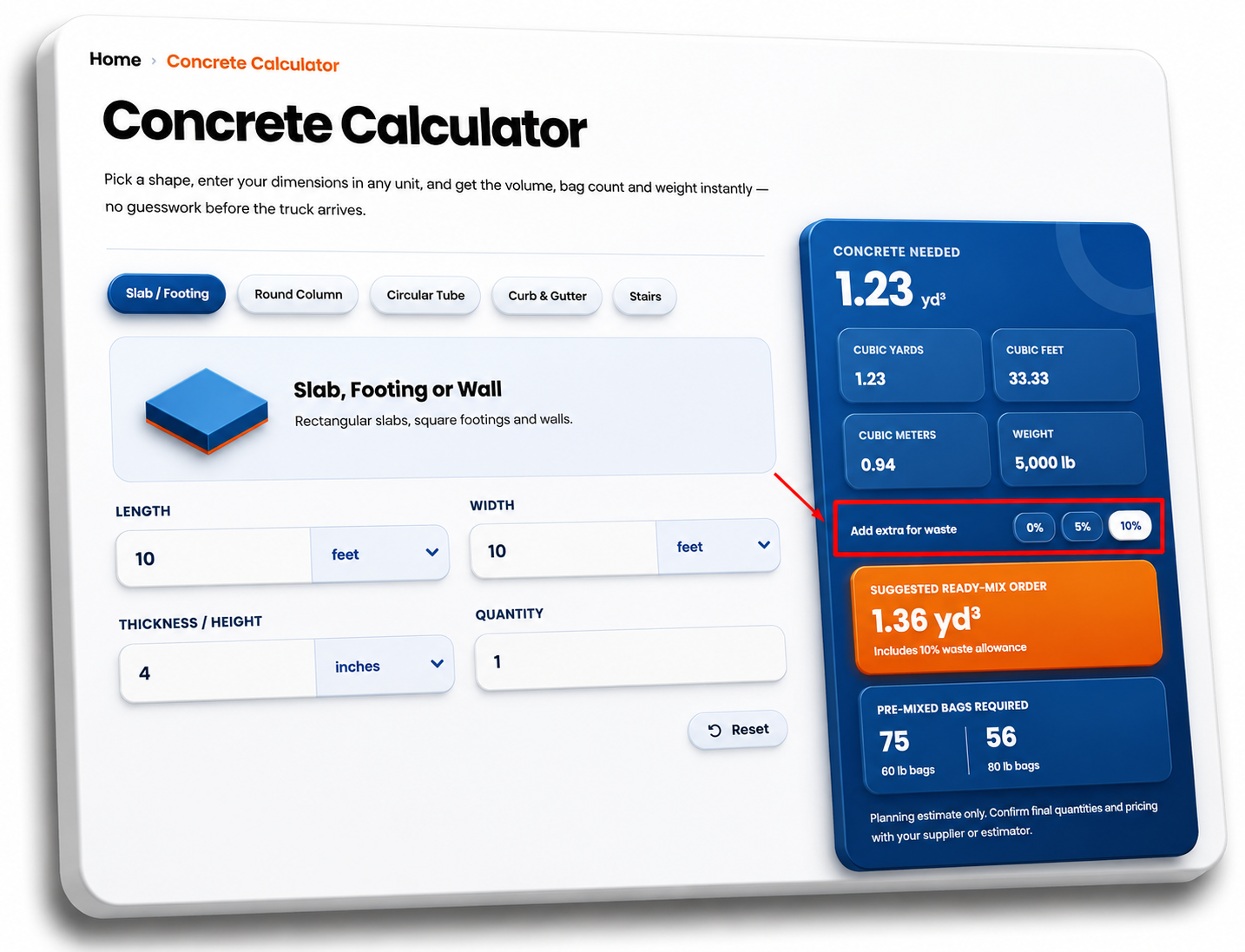
Choose 0%, 5%, or 10% overage. Concrete work is never perfectly clean. Uneven subgrade, spillage, and slightly over-dug footings all eat into your total, so most crews add 5% to 10% so they never come up short mid-pour.
-
Read your results
The calculator returns your concrete needed in cubic yards, cubic feet, and cubic meters, plus an estimated weight. It also gives a suggested ready-mix order and the number of 60 lb and 80 lb bags the job would take, so you can decide between bags and a truck delivery at a glance.
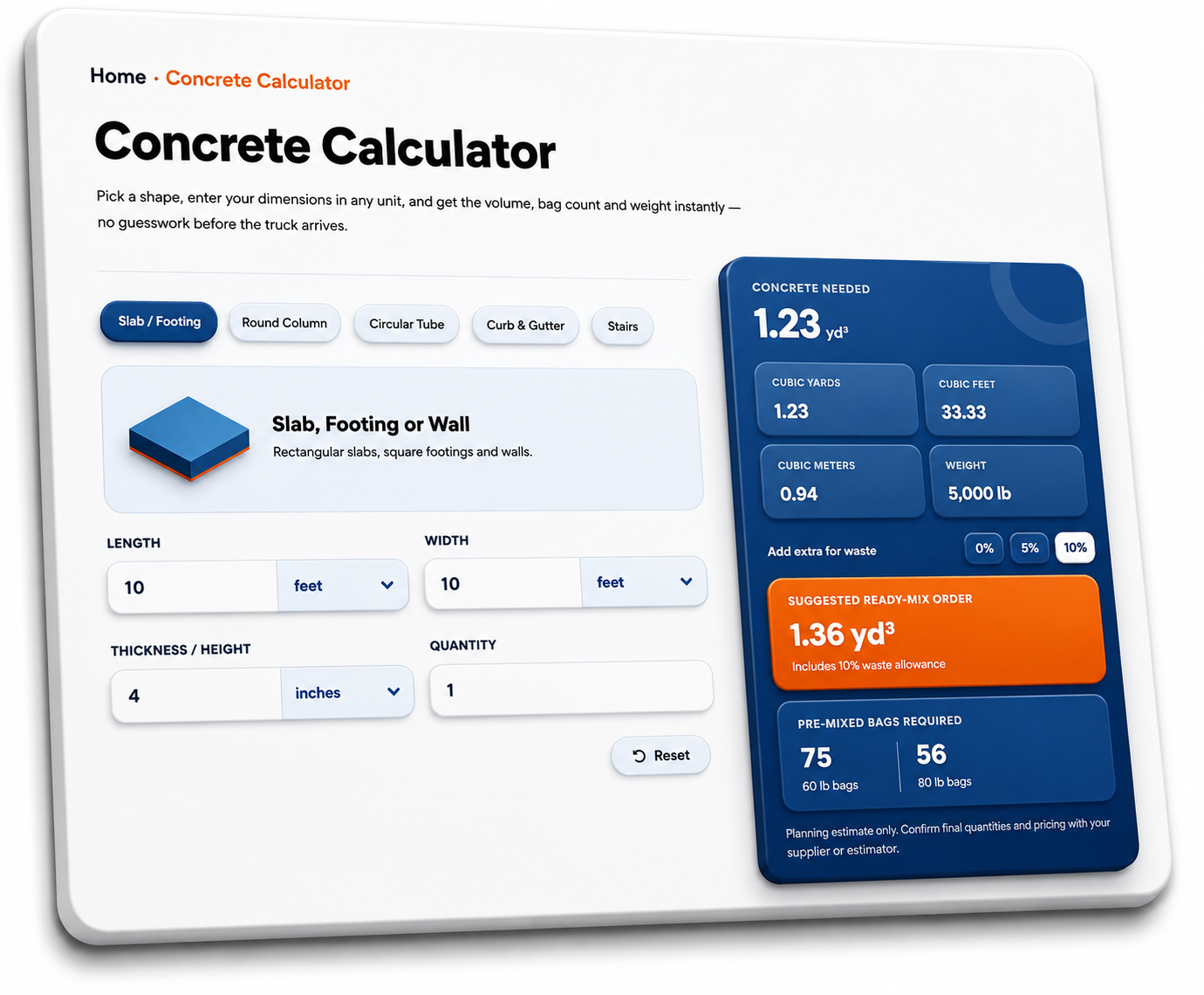
The output is a planning estimate. Always confirm final quantities and pricing with your supplier or your estimator before you place the order.
What Is Concrete?
Concrete is a mix of cement, water, and aggregate (sand and gravel or crushed stone). When water hits the cement, it starts a chemical reaction called hydration, and over the following days and weeks the mix hardens into the strong, durable material used for foundations, driveways, slabs, columns, and countless other structures. It is one of the most widely used building materials in the world because it is strong in compression, shapeable while wet, and long-lasting once cured.
The reason volume matters so much is that concrete is ordered and priced by volume, almost always in cubic yards in the United States. Suppliers do not sell by the square foot or by the guess. They sell by the yard, and ready-mix trucks have minimum loads. If your number is off, the whole pour is affected. That is why a clean volume figure is the single most important measurement before any concrete job begins.
It also helps to know how the units translate. One cubic yard equals 27 cubic feet. At a common 4-inch thickness, one cubic yard covers roughly 81 square feet of slab. For bagged mixes, an 80 lb bag yields about 0.60 cubic feet, so it takes roughly 45 bags to make one cubic yard, while a 60 lb bag yields about 0.45 cubic feet, or about 60 bags per yard. The calculator does this math for you, but knowing the logic helps you sanity-check the result.
When to Use This Calculator
Reach for the concrete calculator any time you need a quantity before you commit money or schedule a truck. The most common moments are:
-
Planning a pour: Before you order, you need to know how many yards or bags the job takes. This is the core use.
-
Budgeting a project: Once you have volume, you can multiply by your local ready-mix price to get a realistic material cost.
-
Deciding between bags and ready-mix: A useful rule of thumb: under one cubic yard, bagged concrete is usually easier and cheaper. Over one yard, ready-mix delivered by truck is almost always the better call, both on cost and on labor.
-
Sizing footings, columns, and stairs: These shapes are easy to underestimate by eye. The calculator handles the geometry so a set of stairs or a round column is not left short.
-
Checking a quote: If a number from a supplier or sub feels off, a quick calculation tells you whether it is in the right range.
Where a quick calculator stops being enough is on real, multi-scope construction projects, where concrete is only one line item against sitework, reinforcement, formwork, and labor, and where a wrong number costs you the bid or the margin. A planning tool gives you a ballpark. A full project needs a proper takeoff.
Benefits of Using This Calculator
-
No more short pours. Running out of concrete mid-pour creates a cold joint, a weak seam that can crack and fail. Getting the number right the first time avoids the rush fee and the structural risk of a second truck.
-
No paying for waste. Overordering means you pay for material that ends up as spoil. The waste allowance toggle lets you build in a sensible buffer without overshooting.
-
Any unit, no manual math. Mix feet, inches, yards, and meters freely. The tool converts everything and returns yards, feet, meters, weight, and bag counts together.
-
Bags or truck, decided fast. The 60 lb and 80 lb bag counts sit right next to the ready-mix suggestion, so the buy decision is obvious.
-
Free and instant. No sign-up, no wait. Enter your dimensions and read your result.
From a Quick Estimate to a Real Bid
This calculator is built to give you a fast, reliable planning number, and for a single slab or a weekend pour that is often all you need. But when concrete is part of a larger job, a foundation package, a commercial slab program, or a full structure, the quantity is only the starting point. You still have to account for reinforcement, formwork, finishing, waste factors that change by placement, and regional pricing that can swing the total by a wide margin.
That is the work our team does every day. Federal Estimating prepares detailed concrete estimating and quantity takeoffs for contractors across the United States, turning drawings into bid-ready numbers you can actually price and win work on. If your project has moved past the calculator stage, we can build the full takeoff for you, usually within 24 to 48 hours.
Working on a real bid? Get your concrete estimate now.